Outdoor events are noisy in every sense of the word. There are crowds, music, competing displays, samples, and enough branded giveaways to fill a closet. In that environment, a business has to do more than simply show up. It needs a space people can spot, understand, and remember.
A 13×20 pop up canopy gives businesses room to do exactly that. It can support displays, demonstrations, customer conversations, staff areas, and bold branding without forcing everything into one tight square. Better still, the same canopy can be arranged differently for trade shows, festivals, sports events, food fairs, and outdoor promotions.
- Think Trade Show, Not Storage Unit
- Make the Roof Do the Long-Distance Work
- A Food Brand Turns Sampling Into a Mini Store
- Build a Festival Layout That Encourages Browsing
- Use Sidewalls to Tell a Visual Story
- A Fitness Company Builds an Outdoor Activation Zone
- Create Zones Without Building Walls Everywhere
- Plan for Real People, Not Perfect Mock-ups
- A Home Services Company Creates a Mobile Consultation Centre
- Keep Branding Consistent Across Different Tent Sizes
- Quality Matters When Your Equipment Has to Keep Showing Up
- Design for Change Instead of One Weekend
- Make the Space Work Harder Than the Square Footage Suggests
- Give Customers Something Worth Photographing
- Make Setup Practical for the Team Using It
- Create an Event Space People Actually Remember
Think Trade Show, Not Storage Unit
One of the easiest mistakes with a larger event space is filling it simply because the room exists.
A 13×20 pop up canopy tent gives you generous square footage, but every table, rack, sign, and display should have a purpose. At a trade show, create a clear front zone for attention and a quieter rear area for longer conversations. The front might feature a hero product or demonstration counter, while the back holds consultations or lead capture. Customers should know where to enter, what to notice first, and where to go next.
Make the Roof Do the Long-Distance Work
Before visitors notice your tables or products, they are likely to see the canopy itself.
That makes the roof and valances some of your most valuable branding surfaces.
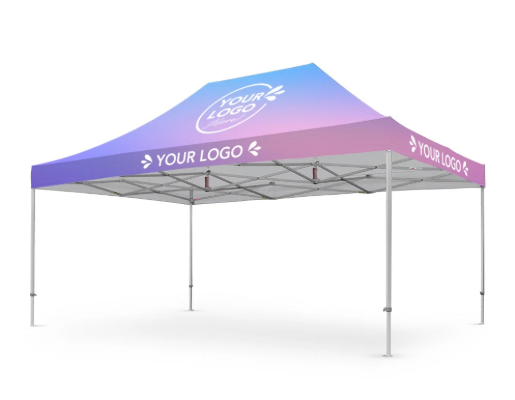
A 13×20 pop up canopy has enough visual scale to stand out in a row of smaller booths. Large logos, recognizable colors, and short messaging make the structure easier to identify across a busy venue. Keep the main graphics simple. A roof is not the place for your company history, four phone numbers, and an inspirational quote from the founder. Let lower walls and displays handle the details.
A Food Brand Turns Sampling Into a Mini Store
Imagine a regional hot sauce company attending food festivals throughout the year.
Its old setup uses two small tents. One tent holds samples and the other contains products for sale. Customers often get confused about where to line up, staff move constantly between the shelters, and the branding looks fragmented.
The company upgrades to a 13×20 pop up canopy.
The front half becomes a sampling station with a long counter and clear flavor labels. The rear half contains packaged products, merchandise, and checkout. Printed walls display colorful food photography, while large roof graphics make the booth easy to recognize from a distance.
The continuous footprint improves traffic flow and gives staff one coordinated working area. Customers can sample, browse, and buy without bouncing between separate tents. The result is not just a bigger booth. It is a smoother customer journey.
Build a Festival Layout That Encourages Browsing
Festival crowds behave differently from trade show visitors.
At a trade show, many attendees are actively comparing vendors and asking detailed questions. At a festival, people may be wandering casually, eating, listening to music, or following friends.
That means your booth needs to give them a reason to slow down.
A 13×20 pop up canopy tent provides enough room for interactive elements without blocking the entire space. A product brand might use one side for samples and another for a photo area, while a retailer can place products around the perimeter and keep the center open. Avoid barricading the entrance with tables. Give people room to step inside.
Use Sidewalls to Tell a Visual Story
Sidewalls are valuable because they can do far more than provide separation.
Printed walls can show lifestyle photography, product benefits, customer results, or project images while making the booth feel more finished. For service businesses, this is especially useful: a contractor cannot bring an entire remodeled kitchen to a festival, but strong project photography can communicate the result instantly. Avoid turning sidewalls into giant brochures; one strong image can beat twenty tiny ones.
A Fitness Company Builds an Outdoor Activation Zone
Consider a fitness studio sponsoring local races and wellness festivals.
The business wants to attract attention, run simple fitness challenges, collect leads, and promote membership offers.
A smaller 13×13 custom canopy might work for a basic information booth, but the company wants visitors to participate in an activity rather than just grab a flyer.
A 13×20 pop up canopy gives the team room to create an activity zone at the front and a consultation area toward the back. One side hosts a short fitness challenge. The other displays membership options, class schedules, and branded merchandise.
After completing the challenge, visitors move toward staff members who can discuss trial memberships and collect contact information.
The additional space turns the booth from a passive display into an experience. When the company only needs a compact sign-up station, a 13×13 custom canopy tent may be the smarter choice.
Create Zones Without Building Walls Everywhere
A 13×20 footprint is large enough to divide into functional areas, but you do not need physical walls separating every activity.
Use counters, tables, rugs, display stands, lighting, and signage to suggest different zones while keeping the space visually connected.
One area can attract attention, another can support hands-on interaction, and another can handle conversions. A technology company, for example, might place a hero product near the entrance, testing tables in the center, and consultation seating toward the back.
Plan for Real People, Not Perfect Mock-ups
Design software is wonderfully cooperative. Real events are not.
Your booth will contain staff, inventory, cords, packaging, and customers who rarely stand exactly where your rendering suggested. Leave breathing room and reserve a back corner for extra stock and personal items. Nothing ruins polished branding faster than a beautiful printed wall with shipping boxes stacked in front of it.
A Home Services Company Creates a Mobile Consultation Centre
Picture a landscaping company attending a regional home-and-garden festival.
The company sells projects that require detailed conversations. Customers want to see examples, discuss budgets, and ask questions about materials and timelines.
A 13×20 pop up canopy tent gives the business enough room to build a small mobile consultation center.
The front area features large project photographs and material samples. The center includes an open display table, while two consultation seats sit toward the rear.
Printed walls help prospective customers visualize completed outdoor spaces, and the larger footprint gives staff enough room to hold meaningful conversations without blocking passing visitors.
The setup makes an intangible service easier to understand and the business more established.
Keep Branding Consistent Across Different Tent Sizes
Many companies own more than one canopy because not every event provides the same booth space.
A 13×13 custom canopy may be perfect for smaller markets, while a 13×20 setup works better for major festivals or product activations.
The branding should still feel like the same company. Use consistent colors, logos, typography, photography, and messaging across tent sizes so customers recognize the brand whether the footprint is compact or expansive. Coordinated counters, banners, flags, and table covers can also move between setups.
Quality Matters When Your Equipment Has to Keep Showing Up
Commercial canopies can be more expensive than lightweight alternatives, and for a business watching expenses, the lowest price can look tempting.
But event equipment should be evaluated by how often it needs to perform.
A frequently used canopy is loaded, unloaded, opened, closed, stored, and exposed to outdoor conditions again and again. Those cycles put pressure on frames, fittings, fabrics, and printed surfaces.
High-quality construction matters because failure at an event can disrupt sales and make the brand look unprepared. A premium 13×20 pop up canopy may cost more upfront because stronger frames, durable fabrics, professional printing, and reliable hardware are not cheap.
For frequent event users, cost per event matters more than purchase price alone. If a well-built canopy supports dozens of promotions over several years, the investment can make far more sense than repeatedly repairing or replacing a cheaper shelter. Presentation matters too. Customers may not know the frame specifications, but they can see faded graphics, sagging fabric, and worn equipment.
Quality is especially important when the canopy is customer-facing. Your event structure is effectively a temporary storefront, and anything that looks tired, flimsy, or poorly maintained can weaken the impression created by the rest of your branding.
A premium canopy should therefore be viewed as equipment your business expects to keep using, not something disposable for one weekend.
Design for Change Instead of One Weekend
A smart canopy should remain useful as campaigns evolve.
Keep permanent graphics focused on the company logo, core colors, evergreen imagery, and long-term messaging. Put seasonal promotions, event dates, and changing offers on removable banners or signs.
That way, the same 13×20 pop up canopy tent can move from a spring trade show to summer festivals, fall community events, and year-end promotions without looking outdated.
This protects the value of premium printing because temporary elements can change without replacing the full canopy.
It also helps businesses maintain a consistent appearance throughout the year. A customer who sees the company at a trade show in March and again at a festival in July should immediately recognize the same brand, even if the promotion inside the booth has changed.
Make the Space Work Harder Than the Square Footage Suggests
A 13×20 footprint gives businesses enough room to be creative without becoming unmanageable.
For trade shows, use the extra length to separate product demonstrations from sales conversations. For festivals, create interactive experiences that pull visitors inside. For outdoor events, build a flexible layout that can handle displays, samples, registrations, or hospitality.
If an event requires a smaller footprint, a 13×13 custom canopy or 13×13 custom canopy tent can provide a more compact version of the same branded experience.
The right choice depends on what customers need to do inside the space.
The right canopy should support the people, products, and activities that make the event worthwhile.
Give Customers Something Worth Photographing
One simple way to extend the value of your event setup is to include an area that people actually want to photograph.
A printed back wall, branded product display, interactive installation, or clever photo backdrop can encourage visitors to create their own content. That matters because a customer photo can carry your branding beyond the physical event and onto social media feeds.
The effect does not require turning the booth into an amusement park. Even a clean, distinctive graphic can provide a recognizable background for pictures.
For businesses attending public festivals especially, this can give the canopy a second marketing role. It attracts people at the event and helps create visual content that may continue circulating afterward.
Make Setup Practical for the Team Using It
Creative booth ideas only work if employees can actually set them up and operate them.
Before committing to a layout, think about transportation, setup time, storage needs, anchoring, and the number of people normally available on event day.
A larger 13×20 pop up canopy should be handled according to the manufacturer’s setup and anchoring instructions. Event organizers may also have specific requirements based on the venue and surface.
The easier your system is for staff to understand, the more consistently it can be used. A beautiful display that requires a complicated reinvention every Saturday morning will eventually become everyone’s least favorite marketing asset.
Create an Event Space People Actually Remember
A 13×20 pop up canopy can become far more than portable shelter. With thoughtful planning, it can serve as a branded store, demonstration zone, consultation area, sampling station, or interactive event experience.
The strongest setups combine visibility with functionality through clear graphics, smart customer flow, organized zones, and enough open space for visitors to engage comfortably.
Premium construction, durable fabrics, professional printing, and dependable components may increase the upfront price, but frequent event users should view those features as investments in reliability, presentation, and long-term value.
Explore high-quality canopy systems, professional printing, branded sidewalls, counters, banners, and accessories designed for commercial use. When your booth is easy to spot, comfortable to explore, and professional enough to represent your business confidently, the canopy becomes part of the reason customers stop in the first place.


